K
Built From Fire
How a New Generation of Architects Is Reshaping Madeira
Architecture & Interiors8 min read
Flying into Madeira, you notice something odd. The island doesn't ease into the ocean like most coastlines. It punches up. Mountains rise almost 1,900 metres from the water. The cliffs don't slope, they drop. And everywhere you look, there's this dark volcanic rock mixed with impossible green.
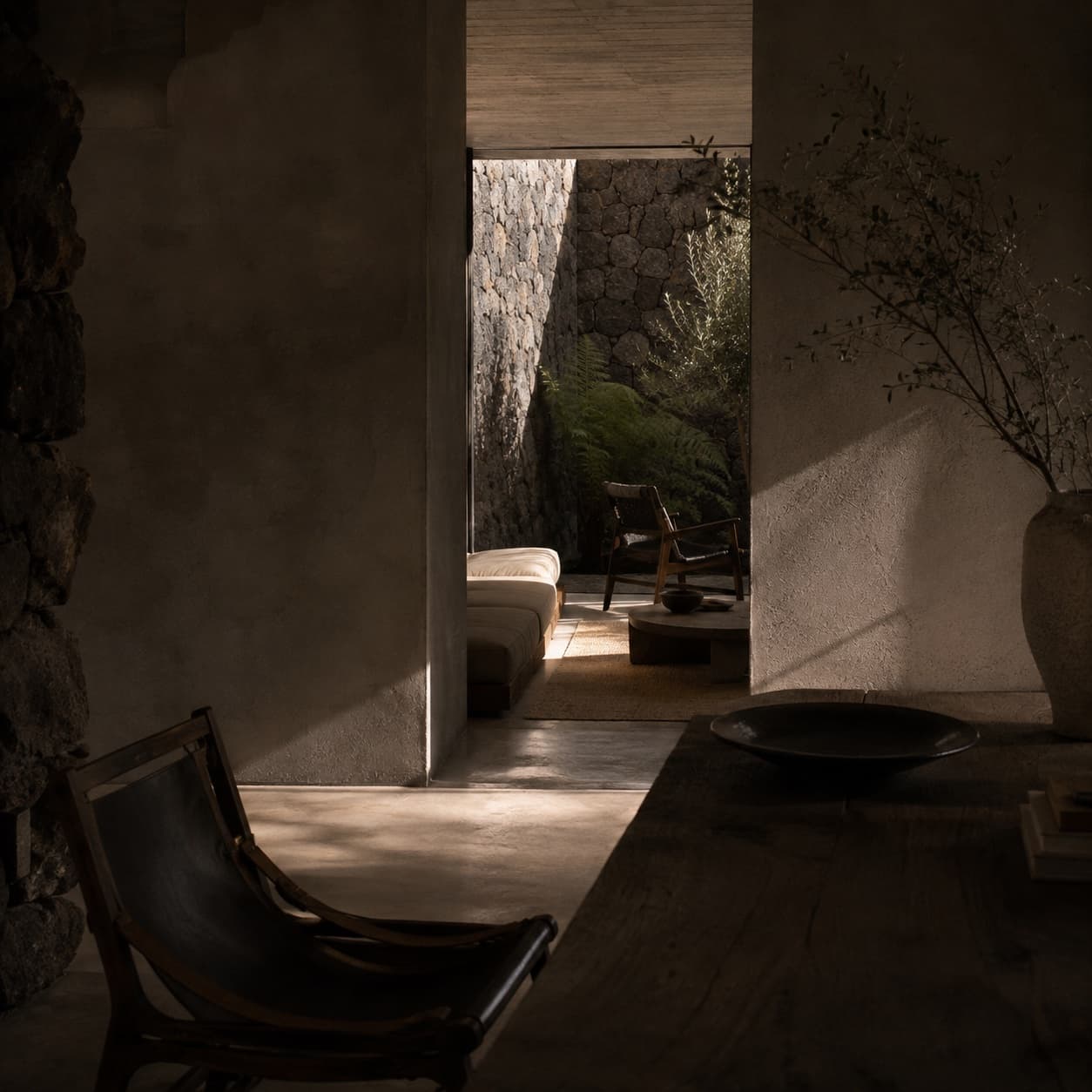
Most travel writing about Madeira focuses on the levadas, the Laurisilva forest, maybe the wine. Fair enough. But spend a few days here and you start noticing the buildings. Not the old quintas or the resort hotels. The new stuff. Houses that seem to grow out of the hillside rather than sit on top of it. Walls made from the same black basalt that forms the cliffs below.
There's something happening here that the design magazines haven't really caught onto yet. While everyone's been writing about the Algarve and Lisbon, Madeira has been quietly developing its own architectural language.
Building with what the volcano gave you
To understand what makes Madeiran architecture different, you need to understand basalt. This dark volcanic stone is everywhere on the island. It's been used in construction here for six centuries: the fortress walls of São Tiago, the cobbled streets of Funchal's old town, the endless agricultural terraces that climb the mountains.
The best architects working here today have figured out that basalt isn't just a building material. It's the whole design vocabulary. When Paulo David built the Casa das Mudas arts centre in Calheta, he didn't just clad the building in basalt. He made it look like it had been carved out of the cliff. You can't tell where the rock ends and the building begins.
The limited land, the predominance of water and an intense nature constitute the dense matter on which my projects are based. Paulo David
David is probably the only Madeiran architect most people have heard of. He won the Alvar Aalto Medal in 2012, which is a big deal in architecture circles. Born in Funchal, studied in Lisbon, worked with Gonçalo Byrne for a decade, then came back home. His buildings are all over the island: swimming pools in Câmara de Lobos, promenades in Salinas, the volcanic interpretation centre in São Vicente.
What's interesting is how his approach differs from mainland Portuguese architecture. The Porto school tends toward calm, meditative spaces. David's buildings have more tension. They respond to a landscape he calls 'naturally violent'. The drama of the terrain becomes part of the architecture.
The studios nobody talks about
Paulo David isn't working alone. Over the past decade, a bunch of smaller studios have set up on the island. Some are run by Madeirans who left, studied abroad, and came back. Others by international architects who got hooked on the design challenges here.
There's Mayer & Selders, founded by a Düsseldorf-trained architect who worked with Paulo David before starting his own practice. He brings German precision but knows the local microclimates and materials. Studio Dois is run by a Dutch-Portuguese couple who moved from the Netherlands to Calheta. They're applying Dutch spatial efficiency to Madeiran hillsides.
What connects these practices is a shared understanding: you can't just import design solutions from flatter, gentler places. Building on a thirty-degree slope above Câmara de Lobos creates problems that a villa in the Algarve never faces. Drainage. Wind exposure. The structural challenge of building into volcanic rock instead of settling onto soil.
The solutions they've developed are genuinely specific to this place. Split-level plans that follow the natural terraces. Cantilevered volumes that minimise ground intervention. Basalt retaining walls that become architectural features. These houses look like nowhere else because they couldn't exist anywhere else.
Four things that define the work here
After spending time with local architects and visiting their projects, a few common principles emerge. Nobody wrote these down in a manifesto. They just show up in the built work.
First, buildings negotiate with the landscape rather than dominating it. Basalt is used structurally, not decoratively. There's material continuity between the architecture and the terrain.
Second, the slope is a feature, not a problem. On an island where flat land barely exists, the best architects work with the gradient. Split-level plans, rooms that step down the hillside, multiple horizon lines within a single house.
Third, the ocean is always present but never passive. Large openings frame the water, but the construction has to withstand salt spray, horizontal rain, and winds that change direction every hour.
Fourth, the climate is mild enough for year-round outdoor living. Courtyards and loggias aren't summer extras here. They're permanent architectural features.
Why the building you sleep in matters
Here's where this becomes relevant if you're planning a trip. In luxury travel, the accommodation is part of the destination. The space you wake up in shapes how you see the island.
More and more of Madeira's best rental properties aren't converted quintas or Mediterranean-style villas. They're purpose-built contemporary homes designed by architects who understand this specific geology and climate. Staying in one of these houses is different from checking into a hotel. The architecture becomes a lens for understanding the place.
Take the Banana House in Arco da Calheta. It's a minimalist residence on a terraced slope within a banana grove. Basalt walls sourced locally. Floor levels that follow the natural terrain. Openings positioned to frame the view from mountain to ocean. The building disappears into the landscape, letting the subtropical green dominate.
A brief history
Madeira's architectural story goes back further than most visitors realise.
15th century: The earliest buildings use basalt and Manueline ornamentation. The Sé Cathedral, São Lourenço Palace, defensive fortresses. The tradition starts with volcanic stone and an orientation toward the sea.
16th to 18th century: Funchal develops its character. Whitewashed walls, wooden balconies, tile mosaics, coloured latticed windows. In Santana, the A-frame houses with thatched roofs emerge.
1990s: Paulo David returns from Lisbon and starts developing a contemporary language rooted in the island's geology.
2004: Casa das Mudas opens. It's Madeira's first building to attract serious international attention.
2010s: International architects start setting up practices here. A new generation of Madeiran architects returns from studies in Lisbon and Porto.
2020s: Remote work accelerates demand for architecturally significant homes. Contemporary villas, particularly along the Calheta coast, reshape the rental landscape.
Why now
There's a reason you're seeing more architectural photography from Madeira on design feeds. A few things are converging.
The climate. Madeira's subtropical weather allows for outdoor living twelve months a year. A contemporary home here can function as an indoor-outdoor space year-round. That makes architectural ambition practical.
The materials. When architects here talk about local materials, they mean basalt from the ground beneath the site. The volcanic geology isn't a theme. It's a constraint that produces specific buildings. A house built from Madeiran basalt on a Madeiran hillside looks different from anything built elsewhere because the material and terrain are genuinely different.
The lack of homogenisation. Ibiza, Mykonos, the Algarve have all developed an interchangeable luxury aesthetic. White volumes, infinity pools, engineered olive trees. Beautiful, but you could be anywhere. Madeira's terrain is too rough, too steep, too dark for that template. The architecture has to be specific.
The immenseness of the ocean is omnipresent. It defines the soul of the island inhabitant, and also shapes its constructions. Paulo David
This isn't about Madeira being the 'new' anything. The island's appeal is that it resists those comparisons. It's too vertical, too green, too geologically dramatic to fit an existing template.
For travellers looking beyond the familiar Mediterranean circuit, Madeira offers something increasingly rare: a place where the landscape is more powerful than the architecture, and where the architecture is good enough to know it. Where the house you stay in becomes a way of understanding the volcanic, subtropical, Atlantic reality of the island.
That's what it means to travel for architecture. And Madeira has quietly become one of the best places in Europe to do it.
K
Written by